Quick answer
What are the pros and cons of stone veneer?
Stone veneer gives you the look of a stone wall at a fraction of the weight, with no footing or ledge needed. Manufactured stone is light, lower in material cost and easy to shape. Natural thin stone is real rock with color all the way through. The main risk for both is water: if the barrier, flashing and weep screed behind the stone are wrong, moisture gets trapped.
What Is Stone Veneer?
Stone veneer is a thin layer of stone attached to the face of a wall. It does not hold the wall up. Natural stone veneer is real quarried stone sawn thin. Manufactured stone veneer is lightweight concrete cast and colored to look like stone. Both are set in mortar on a prepared wall, so neither needs the foundation ledge that full-depth stone requires.
Full-depth stone
Traditional stone, often 3 to 5 inches deep, laid like brick on a footing or foundation ledge and tied back to the wall. It is the heaviest and most labor-intensive option.
Natural thin stone veneer
Real stone cut thin, with matching corner pieces. It is light enough to adhere, so it can go on framed walls, existing masonry and interior walls without a ledge.
Manufactured stone veneer
Lightweight concrete poured into molds made from real stone and colored with pigments. One major manufacturer describes it as about a third the weight of natural stone.
Thin brick
Real clay brick made thin and adhered the same way. More on that below.
Natural vs Manufactured Stone Veneer
Natural stone veneer is real rock, so the color runs all the way through, it does not fade, and every piece is different. It costs more to buy. Manufactured stone veneer is lighter, lower in material cost and very consistent, but its color comes from pigments, so deep chips can show a different color and some products fade slowly in strong sun. Both need the same careful water management.
| Natural thin stone | Manufactured stone | |
|---|---|---|
| What it is | Quarried stone sawn thin | Lightweight concrete cast and colored to look like stone |
| Weight | Light enough to adhere, but usually heavier than manufactured | The lightest stone option |
| Color | Natural and through the whole stone; does not fade | Pigment based; consistent, may fade slowly over years of sun |
| Look | Every piece different, real texture | Realistic, though shapes can repeat on large walls |
| Material cost | Higher | Lower |
| Cutting and corners | Harder to cut; corner pieces sold separately | Easy to cut and shape; molded corner pieces |
| Winter concerns | Depends on the stone; dense stone handles freeze-thaw well | Deicing salt can damage the surface, so keep it away |
| Best fit | Fireplaces, accent walls, high-end exteriors | Wainscots, columns and larger exterior areas on a budget |
Stone Veneer Pros and Cons
The pros: it looks like real masonry, adds texture to a siding home, needs little upkeep once installed, and goes where full stone cannot because it needs no ledge. The cons: it depends completely on proper water management behind it, mistakes stay hidden until damage shows, repairs can be hard to match, and it usually costs more per square foot than vinyl siding.
Pros
- The look of a stone wall without the weight or a footing
- Low maintenance: no painting, and the stone itself rarely wears out
- Works outside and inside, from wainscots to fireplace walls
- A stone wainscot protects the bottom of the wall from splash-back, snow and mower debris
- Natural stone color never fades
Cons
- Water management behind the stone has to be right, every time
- Failures are hidden: rot can start behind the stone before you see anything
- Manufactured stone can fade, and chips may show a different color
- Deicing salt can damage manufactured stone near steps and walks
- Matching a repair years later can be hard if a color is discontinued
Where Stone Veneer Works on Your Home
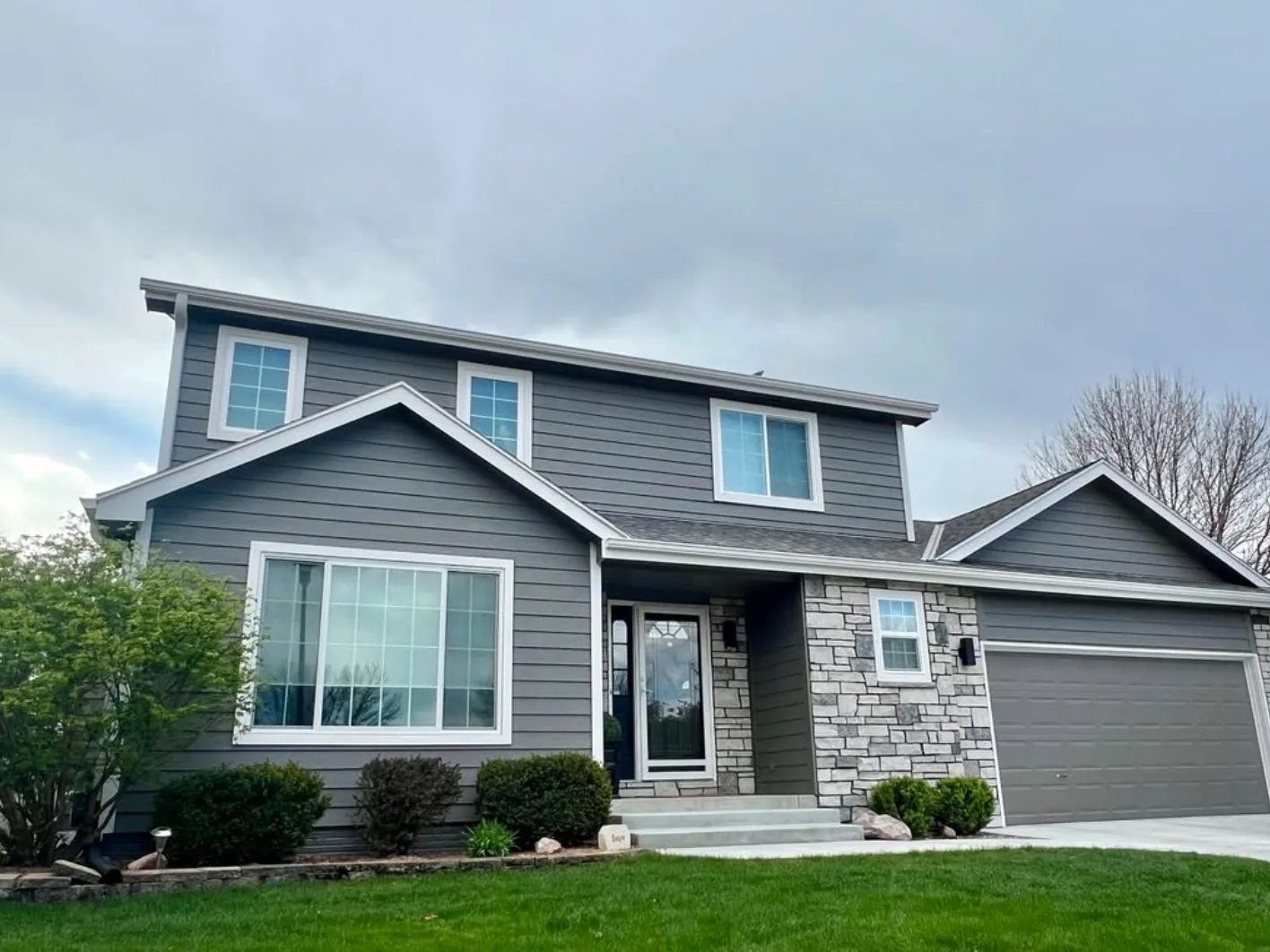
Stone veneer is most common as a wainscot along the bottom of a siding home, on porch and garage columns, around entries, on accent walls, and on fireplace surrounds inside. A wainscot is a smart spot because the bottom few feet of a wall take splash-back, mower debris and drifting snow, and stone handles that abuse better than most siding.
Wainscots
A band of stone from the ground up to about window-sill height, topped with a sill stone that sheds water. It pairs well with lap siding; see our siding page if you are redoing both.
Columns
Stone wraps on porch and garage columns, built over a framed or block core.
Stone fireplace surrounds
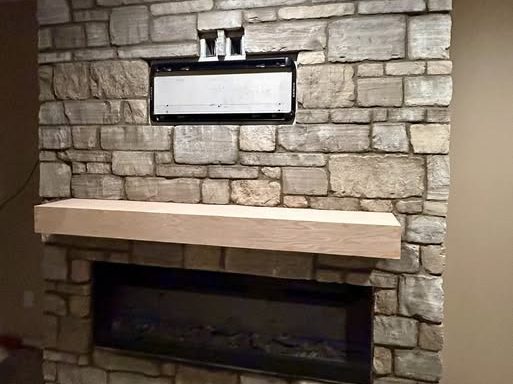
Stacked stone or thin brick from the hearth to the mantel or ceiling. A stone fireplace surround is one of the most popular indoor uses. The fireplace maker's clearance rules come first, and the stone goes over a non-combustible backer where required.
Accent walls and entries
Feature walls inside, and stone around the front entry outside.
Thin Brick: Real Brick Without the Weight
Thin brick is real fired clay brick made thin, usually about half an inch to an inch thick, and adhered to a wall like stone veneer. It gives you a true brick face on interior walls, fireplace faces, remodels and exterior walls with no foundation ledge. Because it is clay, the color does not fade, and it handles weather like full brick when installed right.
- Inside: accent walls, kitchen backsplashes, fireplace faces and basement walls.
- Outside: wainscots and accent areas where adding a full brick ledge is not practical.
- Corners: L-shaped corner pieces make the wall read as full brick.
- Prep: exterior thin brick needs the same water-resistive barrier, lath and drainage details as stone veneer.
For full-size brick, block and new masonry, see our main masonry contractor page.
Moisture Management: How Stone Veneer Fails and How to Prevent It
Stone veneer is not waterproof. Rain soaks into the stone and mortar and reaches the wall behind it, so that water needs a way out. On framed walls that means a water-resistive barrier, metal lath, a mortar scratch coat, flashing at openings and a weep screed at the bottom. When those are skipped, water sits against the sheathing and rots it, often without showing on the face.
The basics behind a dry stone wall
- Water-resistive barrier. On wood-framed walls, stone makers commonly call for two layers, so water that gets past the first can drain down and out.
- Weep screed. A metal strip at the base that lets water escape. Installation guides call for the stone to stop about 4 inches above soil or 2 inches above paving.
- Flashing. At windows, doors, roof lines and where stone meets siding. A kickout flashing where a roof edge meets a stone wall sends runoff away from the stone.
- Sill and cap stones. Sloped to shed water off the top of a wainscot.
- No trapped moisture. If a sealer is used at all, it should be breathable.
Warning signs on an existing wall
- Stains or white powder below windows or at the base
- Stone buried in soil or mulch with no clearance
- Soft or stained drywall or trim inside the same wall
- Cracked joints or loose stones
Nebraska freeze-thaw makes trapped water worse, because wet stone and mortar freeze, expand and loosen over a few winters. The same drainage ideas apply to stucco and EIFS, which fail in similar ways.
Stone Veneer in Lincoln, NE: How Installation Works
A stone veneer job in Lincoln, NE starts with choosing the stone and checking the wall, then moves through water management, lath, the scratch coat, setting stone, finishing joints and cleanup. Most of what decides how long it lasts happens before the first stone goes on. With Elevated, you get a free estimate and a written bid before any work starts.
- Pick the stone. Natural or manufactured, the shape and the color. Look at samples outside in daylight, next to your siding and roof.
- Check the wall. Framed walls need full prep. Clean, unpainted brick, block or concrete can often take stone with a bonding coat, while painted or sealed surfaces need lath first.
- Water management. Barrier, flashing and weep screed go on in the right order, lapped so water runs out, not in.
- Lath and scratch coat. Galvanized metal lath is fastened to the framing, then covered with a mortar scratch coat that is scored so the stone grips.
- Set the stone. Each piece is buttered with mortar and pressed in. Corners go first, and stone is pulled from several boxes so the color mixes evenly.
- Finish the joints. Joints are grouted and tooled, or stone is fitted tight for a dry-stack look.
- Clean up and walk through. Mortar is brushed off the face and you see the finished wall.
What Affects the Cost of Stone Veneer
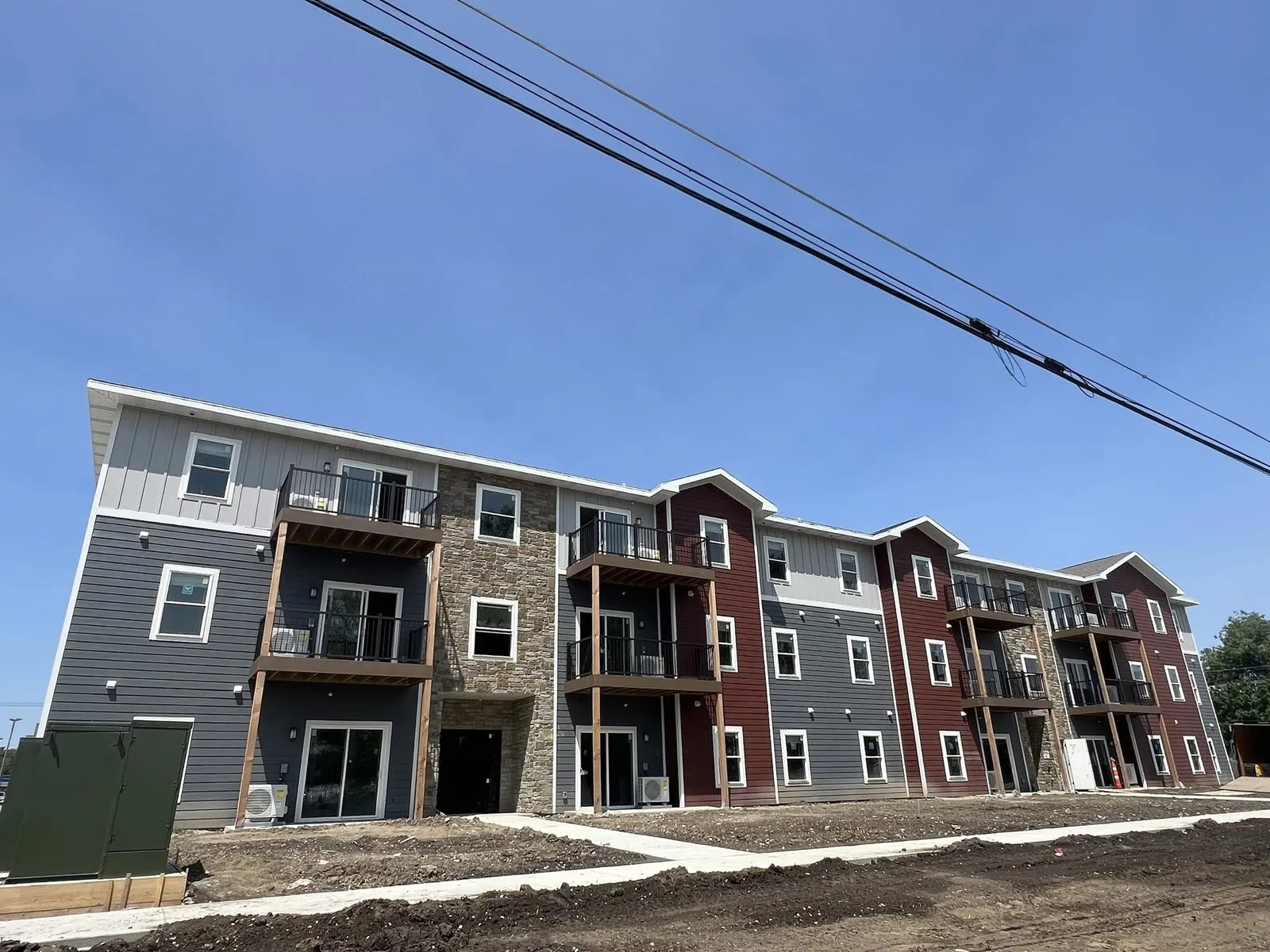
Stone veneer cost is driven by the stone itself, the square footage, the number of corners and openings, and the prep behind it. Natural stone usually costs more than manufactured stone. Corner pieces cost more than flats. Tearing off old siding, fixing damaged sheathing, and adding flashing and weep screed all add to the job, but they are the parts you should never skip.
- Stone type and style. Natural or manufactured, and the specific profile.
- Square footage. Larger areas spread setup costs further.
- Corners and cuts. Outside corners, windows and doors take the most time.
- Wall prep. Siding removal, sheathing repair, barrier, lath and flashing.
- Height and access. Ground-level wainscots go faster than tall walls or chimneys.
- Extras. Sill caps, hearths, mantels and column caps.
- Joint style. Grouted joints and tight dry-stack take different amounts of time.
- Indoor work. Dust protection and fireplace details.
Stone Veneer Installers Serving Lincoln and Nearby Towns
We install stone veneer and thin brick across Lincoln and nearby towns including Hickman, Waverly, Ashland, Seward, Milford and Grand Island. Before you hire anyone, ask how they handle the barrier, weep screed and flashing. Call Brenton at (402) 417-3937 for a free estimate, or Trey at (402) 641-7709 in Seward and Seward County.
Questions to ask a stone veneer installer
- How many layers of water-resistive barrier will you use on my wall?
- Where will the weep screed go, and how much clearance will there be above soil and paving?
- How will you flash windows, doors and roof lines?
- Will you mix stone from several boxes?
- Can I see photos of stone work like mine?
Town pages: new construction in Hickman, exterior projects in Waverly and contractor services in Ashland.